
Choose a pet store theme by catalog size, filtering, and mobile speed. Minion, Yuva, and Maximize’s Tender suit pet-focused browsing, Fetch suits accessory shops, and Eurus suits large catalogs that need fast pages. Prices run from $100 to $430.
Starting a pet store online can be a rewarding venture, and choosing the right platform is crucial for success. Shopify has emerged as a leading e-commerce platform, offering a user-friendly interface and a wide range of features. However, the theme you select plays a significant role in attracting customers and driving sales. This article will explore the top 10 best Shopify themes for pet store, helping you find the perfect fit for your business.
Factors to consider when choosing a Shopify pet store theme
Before diving into the list of themes, let’s discuss the key factors to consider:
- Visual Appeal: The theme should be visually appealing and reflect the nature of your pet store. Consider themes with warm, inviting colors and imagery that resonate with pet lovers.
- Mobile Responsiveness: In today’s mobile-first world, your theme must be mobile-responsive. This ensures your store looks great and functions flawlessly on all devices, from smartphones to tablets and desktops. A study by Statista found that mobile commerce accounted for a significant portion of online sales, highlighting the importance of mobile optimization.
- Functionality: Consider the specific features you need, such as product filtering, search functionality, customer reviews, and integration with social media platforms. For a Shopify pet theme, features like pet breed filters or size guides can be particularly helpful.
- Customization: Choose a theme that allows for easy customization, so you can tailor it to your brand’s unique style and needs.
- SEO Friendliness: A well-coded theme can significantly impact your search engine rankings. Look for themes optimized for SEO, with features like clean code, fast loading speeds, and support for meta descriptions.
- Support: Ensure the theme provider offers reliable support in case you encounter any issues.
Quick comparison: 10 Shopify themes for pet stores
Theme | Best for | Price | Merchant rating |
Maximize (Tender preset) | Large pet catalogs and wholesale (B2B) | $220 | 100% (53 reviews) |
Expanse (Fetch preset) | Pet accessory shops | $400 | 97% (29 reviews) |
Minion | Tight budgets, filtering by pet type | $100 | 82% (33 reviews) |
Yuva (Woofy preset) | Pet brands that sell on storytelling | $350 | 94% (127 reviews) |
Honey | Premium pet boutiques | $400 | 94% (51 reviews) |
Stockmart | Multi-category catalogs, no pet look needed | $380 | 97% (30 reviews) |
Eurus | A proven general base for big ranges | $350 | 99% (605 reviews) |
Boost | Promotion-driven stores | $380 | 87% (82 reviews) |
Paper | A clean base you style yourself | $320 | 96% (53 reviews) |
Vision | Video-led product pages | $430 | 90% (135 reviews) |
How we chose and ordered these themes
We kept themes with a live Shopify Theme Store listing and looked at three things: how clearly the theme is pitched at pet stores, the catalog tools on the listing, and merchant ratings with the number of reviews behind them. Prices, ratings and update dates are as of October 2026.
Themes pitched at pet stores come first, followed by general-purpose themes. Within each group the order is an editorial call, not a calculated score. A listing shows what a theme offers, not how it feels to run, and a rating built on a few dozen reviews is a small sample.
The 10 best Shopify themes for pet stores
1. Maximize (Tender preset): built for large pet catalogs and wholesale
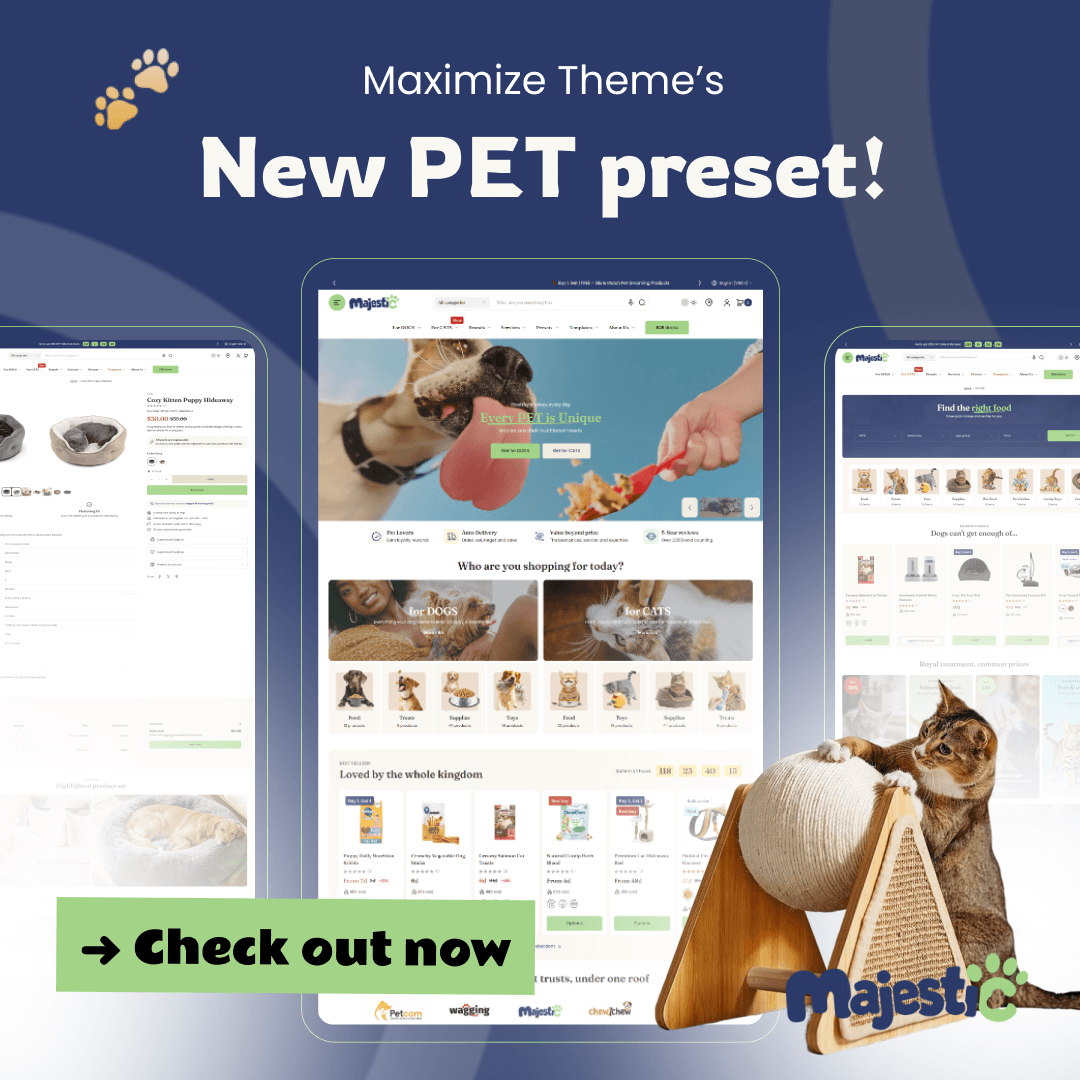
Tender is the preset I would look at first if your pet store has a large, complicated product range. Its Shopify listing is specifically designed around pet retail, with the promise of scaling a pet store without sacrificing the shopping experience. Behind it, Maximize is a premium Shopify theme built for large catalogs and merchants selling to both retail and wholesale customers.
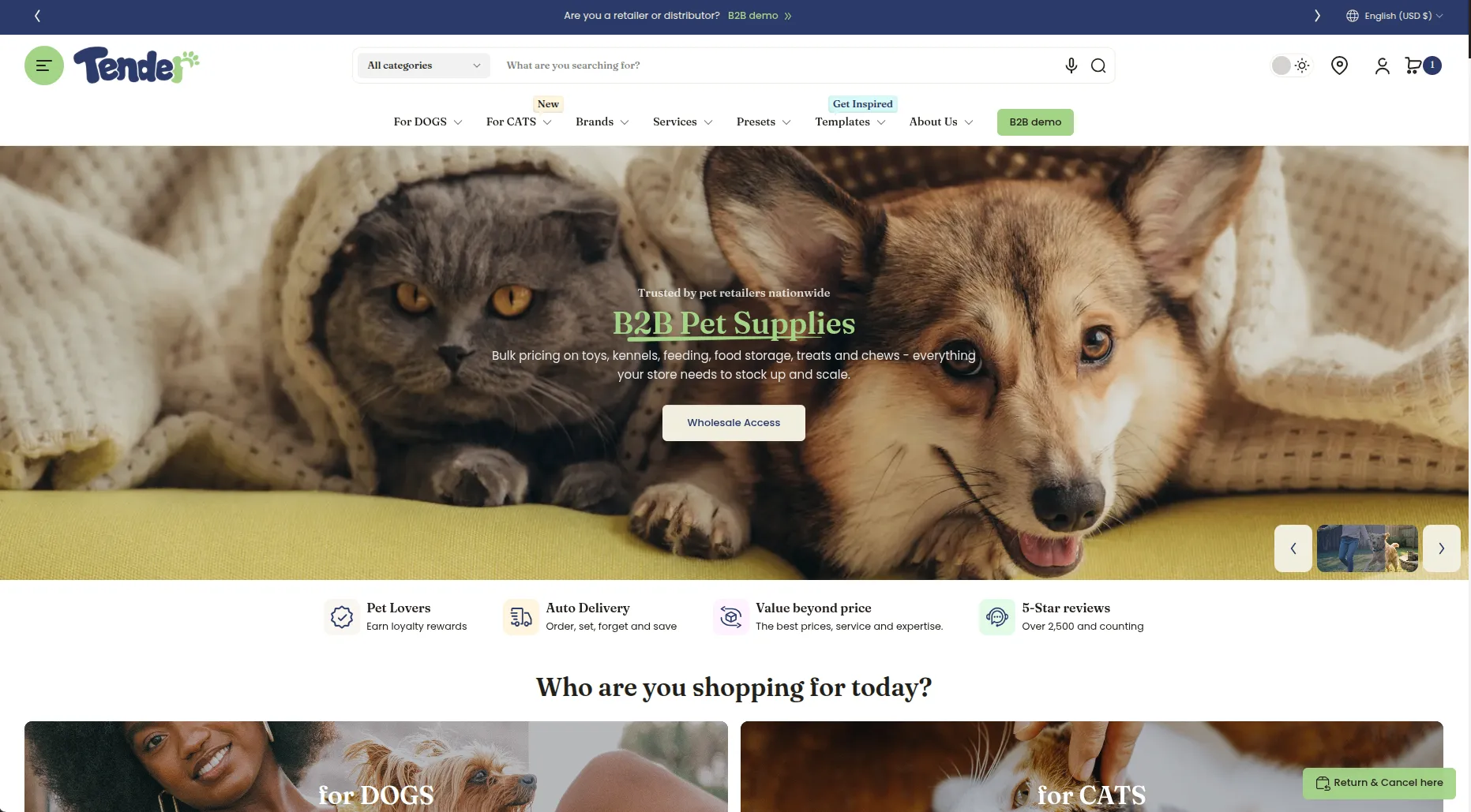
What makes Tender stand out is how its features address the practical problems of running a pet supply store. Shoppers can filter products by pet type, breed or size, while product filtering, swatch filters, a mega menu and infinite scrolling help them navigate larger collections. There is also a quick order list for customers who already know what they need. I particularly like the potential of this combination for stores selling everyday essentials, where customers may want to find and reorder the same food, treats or accessories without browsing the entire catalog again. The listing also includes a merchandising option for ingredients or nutritional information, which is relevant when selling pet food.
Wholesale is another reason to consider Maximize. Its B2B features include request-for-quote functionality, bulk ordering, login-to-see-price and volume pricing. These can be useful if you sell to veterinary clinics, groomers, pet shops or other business customers alongside individual pet owners. However, quantity pricing is marked as a Shopify Plus feature on the listing, so check the requirements for your Shopify plan before making a decision.
At $220, Maximize offers a relatively accessible entry point for a theme with this range of catalog and B2B tools. Its Shopify listing currently shows 100% positive feedback across 48 reviews, although that is still a smaller review base than some established alternatives. My take: this is the strongest fit for a growing pet retailer with hundreds of products or a genuine wholesale operation. If you sell a small, carefully curated collection of collars, toys, or handmade accessories, much of its functionality, you can also try Tender, as it has a long range of features at an affordable price.
2. Expanse (Fetch preset): a pet supply theme for smaller shops
Fetch takes a more direct approach: it is designed for pet supply stores rather than being a general-purpose theme that you need to adapt yourself. One merchant on its Shopify listing runs a pet accessories store on the theme, making it a relevant starting point if your business sells products such as collars, leads, toys or other everyday pet essentials

Its feature set covers several useful shopping basics, including Quick Buy, a slide-out cart, pre-orders and size charts. These are particularly relevant to accessory stores, where customers may want to compare sizes, check product options and add items to their carts without navigating through too many pages. The pet-focused design also gives you a starting point for your brand identity instead of requiring you to build everything around a generic storefront.
Where Fetch makes the most sense, in my view, is for a small or medium-sized pet brand that wants a dedicated pet-store design without prioritizing complex wholesale workflows. It is worth checking the available sections and customization options against your actual product range, though. A theme that looks right in the demo may still need considerable work to accommodate your preferred navigation, product information and branding.
There are two points to weigh before buying. Its Shopify listing currently shows 97% positive feedback across 31 reviews, which is encouraging but still a relatively small sample. Also, its last listed update in your comparison was July 2025, making it the oldest update date among these picks at that time. Check the latest release history before committing. I would shortlist Fetch for its pet-specific direction, but compare its customization options and update history carefully rather than choosing it on appearance alone.
3. Minion: the $100 option with pet-type filters
Minion is the budget pick on this list, costing $100, and its Shopify listing explicitly identifies the pet industry as one of its target markets. Its features include filtering by pet type, brand or tag, along with tabbed collections and vertical navigation designed to help shoppers explore extensive product ranges. For more detail, see our Minion theme review.

The filtering options are the main reason I would consider Minion. Imagine a store selling products for dogs, cats, birds and small animals, with different brands and product types under each category. A shopper should be able to narrow down the options without clicking through a long series of collections. Minion gives you a foundation for organizing that kind of catalog, while its customizable sections let you shape the storefront around your products.
The trade-off is its customer feedback. The Shopify listing currently shows 82% positive ratings across 33 reviews, the lowest percentage among the themes in this comparison. That does not automatically mean the theme will be a poor fit, but it gives you less reassurance than a theme with consistently stronger feedback. The relatively small review sample also means the rating should be interpreted cautiously.
My recommendation is to consider Minion if your budget is tight and product discovery matters more to you than having a highly distinctive storefront out of the box. At $100, it leaves more room in your budget for product photography, branding or other parts of the store. Before purchasing, test its mobile navigation and collection pages in the free trial, particularly if you have a deep catalog. Those are the areas where a store’s organization needs to work well in practice, not just look good in a demo.
4. Yuva (Woofy preset): a pet-brand look with a real review base
Yuva’s Woofy preset is aimed at modern pet brands, making it a natural option if you want your store to feel more like a cohesive lifestyle brand than a traditional pet supply catalog. Its Shopify listing offers a ready-made design direction that you can adapt with your own photography, colors and product content. The underlying Yuva theme is also actively maintained, with version 13.0.7 released in September 2026.

What appeals to me about Woofy is its suitability for brands that need to communicate a particular look and personality. Lifestyle imagery, icons and storytelling blocks can help you show how your products fit into everyday life with pets. This is especially useful for brands selling premium accessories, grooming products or treats, where the presentation and identity of the brand matter alongside the product specifications.
Yuva also includes features such as back-in-stock alerts, a stock counter, countdown timers and a slide-out cart. These give you options for communicating product availability and promotions, although the value of each feature depends on how you run your store. For example, back-in-stock alerts are relevant if customers regularly look for replenished products, while countdown timers make more sense when you actually run time-limited offers.
The theme has a stronger review base than several of the more niche options here: its Shopify listing shows 94% positive feedback across 127 reviews. That provides a broader set of merchant experiences to consider, although ratings alone cannot tell you whether a theme will suit your particular setup.
I would put Woofy on the shortlist for a pet brand with a recognizable visual identity and a moderate product range. It gives you a pet-oriented starting point without limiting you to a strictly utilitarian storefront. If your main challenge is helping shoppers navigate hundreds or thousands of SKUs, however, compare its collection and filtering experience with themes built specifically for larger catalogs before deciding.
5. Honey: the boutique pick for premium pet brands
Honey is explicitly marketed for pet brands selling to dog, cat and horse owners. Its Shopify listing includes visual merchandising features such as before-and-after sliders, image hotspots, lookbooks and customizable product options. These make it worth considering if your products benefit from strong imagery and a more polished presentation.

Of the themes on this list, Honey is one I would investigate first for a boutique brand selling premium pet accessories, personalized products or design-led items. Image hotspots can connect lifestyle photography with individual products, while lookbooks help you present a collection as part of a larger visual story. Product options are also worth exploring if shoppers need to select variations or customize their purchases.
Honey’s feature set extends beyond presentation. The current listing highlights built-in upsells and bundles, alongside customization options that can let shoppers personalize products without an additional app. Whether these features are useful depends on your business model: a brand selling matching collars and leads, for instance, may have different merchandising needs from a store primarily selling standard bags of pet food.
Merchant feedback is encouraging, with 94% positive ratings across 51 reviews on Shopify. However, that is still a relatively small sample, and the listing also includes a negative review from a pet merchant who reported a mismatch between the advertised demo and the delivered result. That is a useful reminder to preview the actual theme and clarify any setup expectations before buying.
At $400, Honey is a considerable investment for a small store. I would choose it when visual presentation, brand storytelling and product customization are central to the shopping experience, not simply because the pet-specific design looks attractive. If you mainly need practical filters, straightforward product pages and an economical way to list everyday supplies, a less expensive theme may be sufficient.
6. Stockmart: a general-purpose rival for large catalogs
Stockmart is designed for stores with extensive product collections. Although its positioning and demo designs lean toward electronics rather than pet supplies, the underlying features are relevant to any retailer that needs to organize a large inventory. Its Shopify listing highlights smart filtering, swatch filters, a mega menu, quick view and other conversion-oriented tools.

For a pet retailer, I see Stockmart as an option worth considering when the catalog matters more than having a pet-specific visual identity. A store selling hundreds of products across food, grooming, toys, bedding and accessories needs a clear hierarchy, useful filters and navigation that makes sense to shoppers. Stockmart provides tools for building that structure, while its modular design gives you flexibility in how you present different collections.
The important distinction is that a large-catalog theme is not automatically a good fit for every large catalog. You still need to check whether its navigation can accommodate your category structure and whether the available product filters support the attributes your customers use to compare items. For example, a pet food retailer may need shoppers to distinguish products by animal type, life stage or dietary requirements. Do not assume that a theme’s general filtering features automatically provide every filter you need; your product data and Shopify setup also matter.
Stockmart costs $380 and currently has 97% positive feedback across 30 reviews on Shopify. That is a promising rating, but the sample is small compared with more established themes. It also lacks the pet-specific direction offered by Tender or Woofy, so expect to spend time adapting the design and product content to your brand.
My take: Stockmart is worth a closer look if you have a broad inventory and prefer a general-purpose catalog layout. However, I would compare it directly with Maximize before buying. If you also sell wholesale, Maximize’s built-in B2B positioning may make it the more relevant choice; if you only need a general storefront for a large retail catalog, Stockmart remains an alternative to evaluate.
7. Eurus: a proven general-purpose base for big ranges
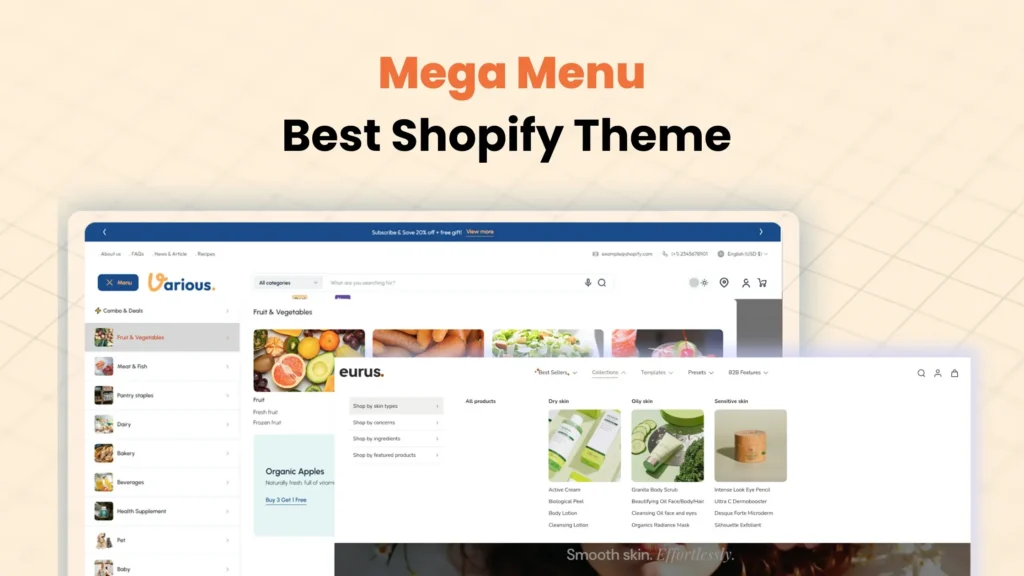
Eurus does not have a dedicated pet-store preset on its Shopify listing, however, the theme used to have one called “Breath”. Therefore, you still can create the pet-store identity through your own photography, colors, and page layouts (or use their free design & consulting services). It offers a broad set of tools for building and organizing a substantial catalog, including product filtering, swatch filters, a mega menu, infinite scrolling, and enhanced search. It also includes more than 52 built-in sections for customizing your pages.

The strongest argument for Eurus is its track record. Its Shopify listing currently shows 99% positive feedback across 605 reviews, giving it one of the largest review samples among the themes in this comparison. That does not guarantee a trouble-free setup, but it provides more merchant feedback to examine than most of the alternatives here.
From a practical perspective, I would consider Eurus for a pet retailer that wants flexibility rather than a predefined pet aesthetic. You could build separate shopping journeys for dogs, cats and other animals, then use collection pages and product sections to present different product categories. Its broad selection of sections also gives you room to experiment with homepage layouts, educational content and product merchandising as the store develops.
Eurus is also worth considering if your business has more than one sales channel or customer type. Its broader feature set includes tools for product discovery, merchandising and B2B-oriented selling. However, features such as quantity pricing may require Shopify Plus, so check the plan-specific limitations rather than assuming everything is available on every Shopify subscription.
At $350, Eurus is more expensive than Maximize and Minion, and it requires more work to establish a distinctive pet-store identity than a dedicated preset. I would choose it if you value a well-established theme with extensive customization options and are prepared to build your own design direction. If you want a ready-made pet-store experience or built-in B2B functionality as the primary deciding factor, compare it with Tender and Woofy first.
8. Boost: a sales-focused all-rounder
Boost is a general-purpose Shopify theme built around merchandising and promotional tools. Its Shopify listing highlights customizable sections, promotional features, product filtering and other tools intended to support the shopping experience. It does not have a pet-specific preset, so you would need to adapt the design to suit your brand.

What makes Boost interesting is its emphasis on promotions and merchandising. If your pet store regularly runs seasonal campaigns, offers discounts on selected products or features special bundles, its promotional sections and product badges give you options for communicating those offers. Filtering and navigation features also help you organize your collections, although you should test them against your actual catalog before committing.
I would see Boost as a better fit for a retailer whose storefront needs to support frequent campaigns than for a business whose main challenge is complex wholesale ordering. For example, a pet shop promoting seasonal toys or discounted accessories may make good use of its merchandising options. A specialist food retailer with a large inventory and business customers, on the other hand, may benefit more from a theme with stronger catalog or B2B positioning.
The main consideration is its review record. Boost currently has 87% positive feedback across 82 Shopify reviews, making its rating weaker than those of several alternatives on this list. The reviews also illustrate why it is worth checking individual features rather than relying on a headline rating: one merchant, for example, reported that the theme lacked a cart drawer option.
At $380, Boost is not a budget purchase. I would shortlist it if its promotional design and available sections match how you sell, but test the cart experience and mobile shopping journey carefully. If your store does not rely heavily on promotions, you may find that a more catalog-oriented or pet-specific theme is a better use of your budget.
9. Paper: a clean, general-purpose base
Paper is a general-purpose theme for large-catalog storefronts. Its Shopify listing includes infinite scrolling, a mega menu, enhanced search, product filtering, a stock counter and other features that help customers explore a store. It does not specifically target pet retailers, so its suitability depends on how well you can adapt the design to your brand.

Paper’s appeal is its balance between a clean visual presentation and practical catalog tools. For a pet store with strong product photography, a relatively uncluttered layout can help products remain the focus instead of overwhelming shoppers with promotional elements. Its flexible sections also give you room to introduce your own branding, explain product benefits and organize collections without relying entirely on a preset design.
I would consider Paper for a store selling curated pet accessories, premium toys or other products where clear photography and straightforward navigation are priorities. Its filtering and search features can also be useful for a broader inventory, but I would still test the collection pages with your actual product attributes. A theme can provide filtering tools without automatically solving the challenge of organizing a complex catalog.
Paper costs $320 and currently has 96% positive feedback across 53 reviews on Shopify. That is a solid rating, although the sample remains relatively small compared with Eurus. The Shopify listing also emphasizes performance-conscious design, but actual storefront speed will depend on factors such as image sizes, installed apps and customizations, so I would test your own store rather than assume a particular result.
My recommendation: Paper is worth considering if you want a flexible, relatively understated foundation for a branded pet store. It is not as directly tailored to pet retail as Tender, Fetch or Woofy, but that may be an advantage if you prefer to build your own visual identity. Just make sure the available sections and navigation match your requirements before choosing it over a more specialized option.
10. Vision: video-friendly, but the priciest here
Vision is a premium general-purpose Shopify theme with a preset called Poochy that gives pet retailers a relevant starting point. Its Shopify listing includes more than 36 sections, product card variations and support for Shopify-hosted product videos. Our Vision theme review explores the theme in more detail.

Vision’s main attraction is the range of ways it lets you present products. Video support, image galleries, hotspots and different product card layouts give you options for showing products from multiple angles or demonstrating how they are used. These features could be useful for pet brands selling harnesses, grooming equipment, interactive toys or other products where shoppers benefit from seeing the item in action.
The Poochy preset also saves you from starting entirely from scratch with a generic design. You can use it as a foundation for your pet-store branding, then adapt the sections and imagery to suit your products. Vision includes catalog tools such as enhanced search, filtering, a mega menu and infinite scrolling, so it is not limited to visual merchandising alone.
However, I would not choose Vision simply because it has video support. Product videos only add value when you have useful footage and a clear reason to show it. If most of your products are standard consumables, such as food, litter or treats, detailed product information and convenient reordering may matter more than elaborate visual presentation.
Vision costs $430, making it the most expensive theme on this list. Its current Shopify listing shows 88% positive feedback across 146 reviews, so its rating is also worth weighing against the stronger scores of several alternatives. Recent reviews include both praise for the theme’s flexibility and support and criticism of performance or support experiences, reinforcing the importance of testing it with your intended setup.
My take: Vision is worth considering for a pet brand that plans to invest in rich product media and wants a flexible design system. But at this price, I would test the demo carefully, check the mobile experience and preview your actual product videos before committing. If you do not need those visual features, a less expensive theme may provide everything your store needs.
What each theme offers a pet catalog
| Theme | Pet signal on the listing | Catalog tools listed | Latest version |
| Maximize | Tender preset: “Scale your pet store without sacrificing shopping experience” | Filtering and sorting, swatch filters, mega menu, infinite scroll, quick order list, quantity pricing (Shopify Plus) | 2.1.0, Sep 2026 |
| Fetch | “Modern pet supply theme” | Filtering and sorting, mega menu, enhanced search, Quick Buy | 4.0.1, Jul 2025 |
| Minion | “Ideal for the pet industry”; pet-type, brand and tag filters | Mega menu, vertical navigation, filtering and sorting | 4.2.0, Jun 2026 |
| Yuva | Woofy preset for pet brands | Filtering and sorting, mega menu, infinite scroll, enhanced search | 13.0.8, Sep 2026 |
| Honey | Marketed for pet brands | Filtering and sorting, swatch filters, infinite scroll, mega menu | 11.0.2, Jan 2026 |
| Stockmart | None (built for extensive collections) | Filtering and sorting, swatch filters, mega menu, quick view | 1.6.1, Oct 2026 |
| Eurus | None (no pet-specific preset) | Filtering and sorting, swatch filters, mega menu, infinite scroll, enhanced search | 10.4.1, Oct 2026 |
| Boost | None | Filtering and sorting, mega menu, enhanced search, stock counter | 8.1.0, Mar 2026 |
| Paper | None | Infinite scroll, mega menu, enhanced search | 8.1.3, May 2026 |
| Vision | None (one preset named Poochy) | Filtering and sorting, infinite scroll, mega menu, quick view | 12.0.0, Feb 2026 |
Other related posts:
Quick chooser: which theme fits your pet store?
- A large pet catalog or a wholesale (B2B) business: choose Maximize with the Tender preset.
- A pet accessory or gift shop with a smaller range: choose Fetch.
- A tight budget and pet-type filtering: choose Minion.
- One pet brand that sells on story and lifestyle photography: choose Yuva with the Woofy preset.
- A premium boutique for dog, cat or horse owners: choose Honey.
- A general store with a big range and no need for a pet look: choose Stockmart or Eurus.
- Constant promotions and flash sales: choose Boost.
- A plain base you will style yourself: choose Paper.
- Video-led product pages: choose Vision.
Final recommendation
Choosing a Shopify theme is easier when you look beyond the store you have today. A few hundred products, multiple sizes of the same food, more categories to manage, and perhaps a groomer asking about bulk orders: as your pet store grows, the way shoppers browse and buy becomes just as important as how your storefront looks.
If that sounds like the direction you’re heading, Maximize’s Tender preset is worth a closer look, particularly for its filtering, quick order list and built-in B2B tools. For a smaller store, Yuva’s Woofy preset and Honey offer more brand-focused starting points, Fetch suits pet accessory shops, and Minion keeps the initial theme cost low. There’s no need to pay for features your business won’t use, or compromise on the ones it needs most.
Before settling on one, open the demo and try it with ten of your own products. Browse the collections on your phone, find a specific item, and see how many steps it takes to add it to your cart. If you sell wholesale, test that buying journey too. The right theme should make these everyday tasks feel natural, leaving you more time to focus on the pets and people your store serves.