The best Shopify theme for a large catalog makes finding, choosing and reordering fast: Hyper has the deepest review record, Empire and Warehouse specialize in retail browsing, and Maximize pairs wholesale tools with a lower price.
Picture a demo store with a dozen products: tidy, quick, convincing. Now load four thousand and ask the question that matters, whether shoppers can still find the right one. That worry is why people search for this, and it is a fair one. Whether you call it a large catalog or a large inventory, the question is the same: can shoppers still find the right product?
A theme can’t organize your catalog, but it decides how easily shoppers use it.
The bar is lower than you might fear. In Baymard’s 2025 benchmark of 170+ leading US and European sites, 78% of mobile product lists were rated mediocre or worse, so a catalog that is easy to browse on a phone stands out. Every price, rating and feature below comes from each theme’s own Theme Store listing, opened on November 6, 2026.
Here are the six side by side, ordered from retail-first to wholesale-first rather than by score.
Theme | Developer | Price | Theme Store rating | Fits best |
Clean Canvas | $420 | 90% positive (113 reviews) | Retail catalogs that lean on built-in promo tools | |
Maestrooo | $320 | 84% positive (326 reviews) | Collection-led retail catalogs | |
Pixel Union | $360 | 79% positive (486 reviews) | Deep retail catalogs with many-variant products | |
Omni Themes | $220 | 100% positive (56 reviews) | Tech-style catalogs that also sell wholesale, at a lower price | |
FoxEcom | $400 | 99% positive (523 reviews) | Wholesale-leaning catalogs that want the deepest review record | |
Shopify | Free | 32% positive (41 reviews) | Wholesale-only catalogs with no theme budget |
What can a theme actually do for a large catalog?
A theme decides how your catalog looks and feels to shop; Shopify sets the rules underneath it. Those rules bite earlier than most owners expect: Shopify’s help page says collections with more than 5,000 products don’t display filters, and a store can run at most 25 filters in total, whatever its theme. No theme rescues a bloated “All products” collection, and Shopify’s own advice is to split it into smaller ones.
What a theme does control is the part shoppers touch: how filters and swatches behave on a phone, how deep the menu goes, whether a wholesale buyer gets a quick order list instead of fifty product pages. That is the lens for the six themes below, and it raises a fair question: if the rules are the same for everyone, why do these themes feel so different?
How did we compare the six themes?
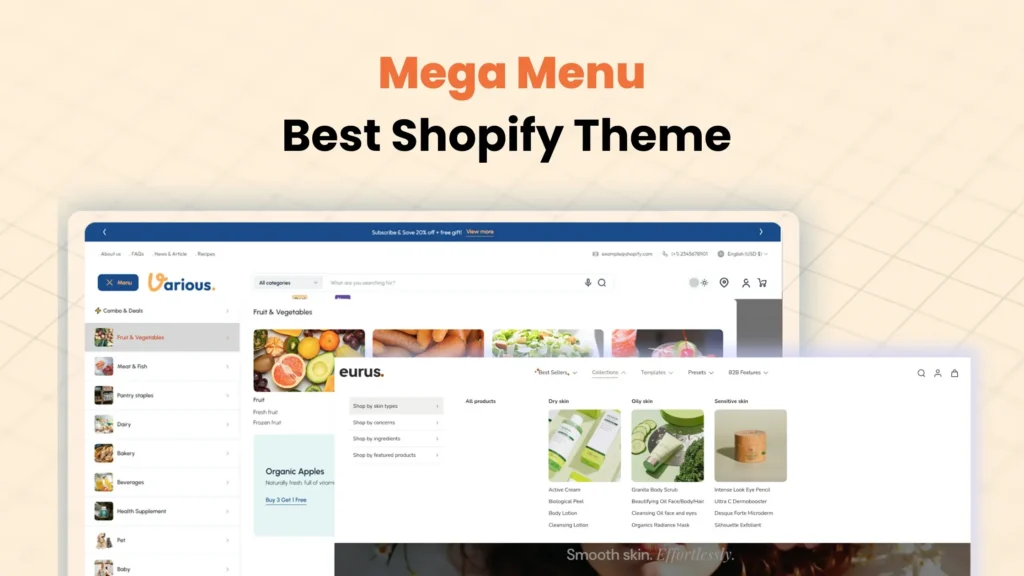
We compared them on four things any large-catalog owner can check on a theme’s own listing: the B2B tools it ships, the share of positive reviews and how many reviews sit behind it, the price, and how recently it was updated. Discovery tools didn’t make the cut. All six advertise the same set: filtering and sorting, enhanced search, a mega menu and swatch filters, so a feature checklist can’t separate them.
The order runs from retail-first to wholesale-first. That is an editorial choice, not a ranking. The method also has blind spots: features are each developer’s own claims, we ran no tests of our own, and load speed is left out because it can’t be judged fairly without the same store running on every theme.
For a wider field than these six, our guide to the best Shopify theme for multiple products compares seven.
What is each theme like for a large catalog?
Each block below says who the theme quietly suits, what you give up by taking it, and one detail the table can’t show.
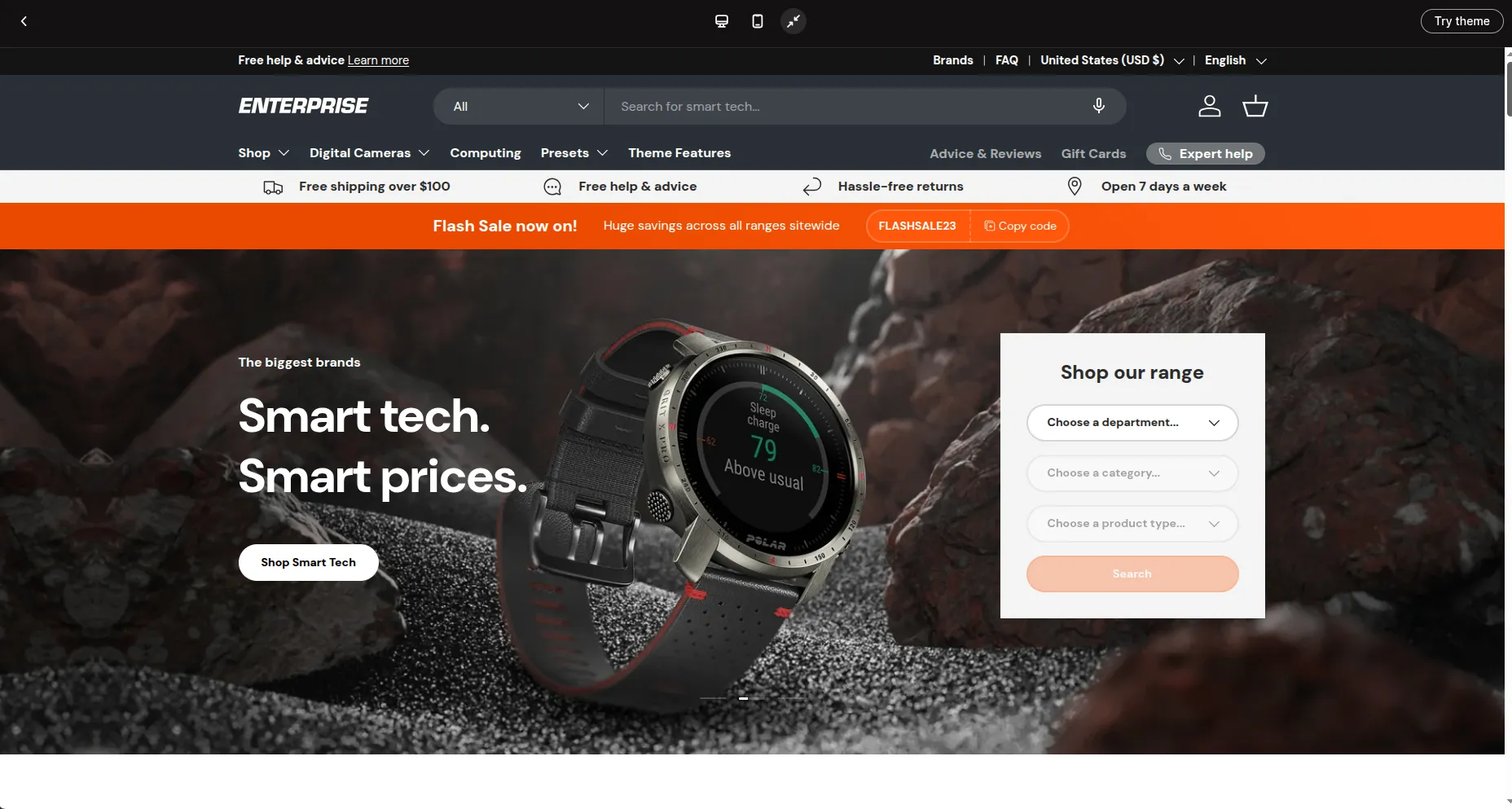
Enterprise: promo tools built in, wholesale tools missing
Enterprise suits a store that sells to shoppers only and wants promo tools built in rather than bolted on. Its listing leans on conversion features such as popups, countdown timers, back-in-stock alerts and pre-orders, and it lists no quick order list, which is fine for retail and a gap for wholesale. Reviews are where it asks for caution: on its page, three of the four newest are complaints about bugs, support or value, and at $420 it is the priciest of the six. If you shortlist it, load your own products into the latest version before you pay.
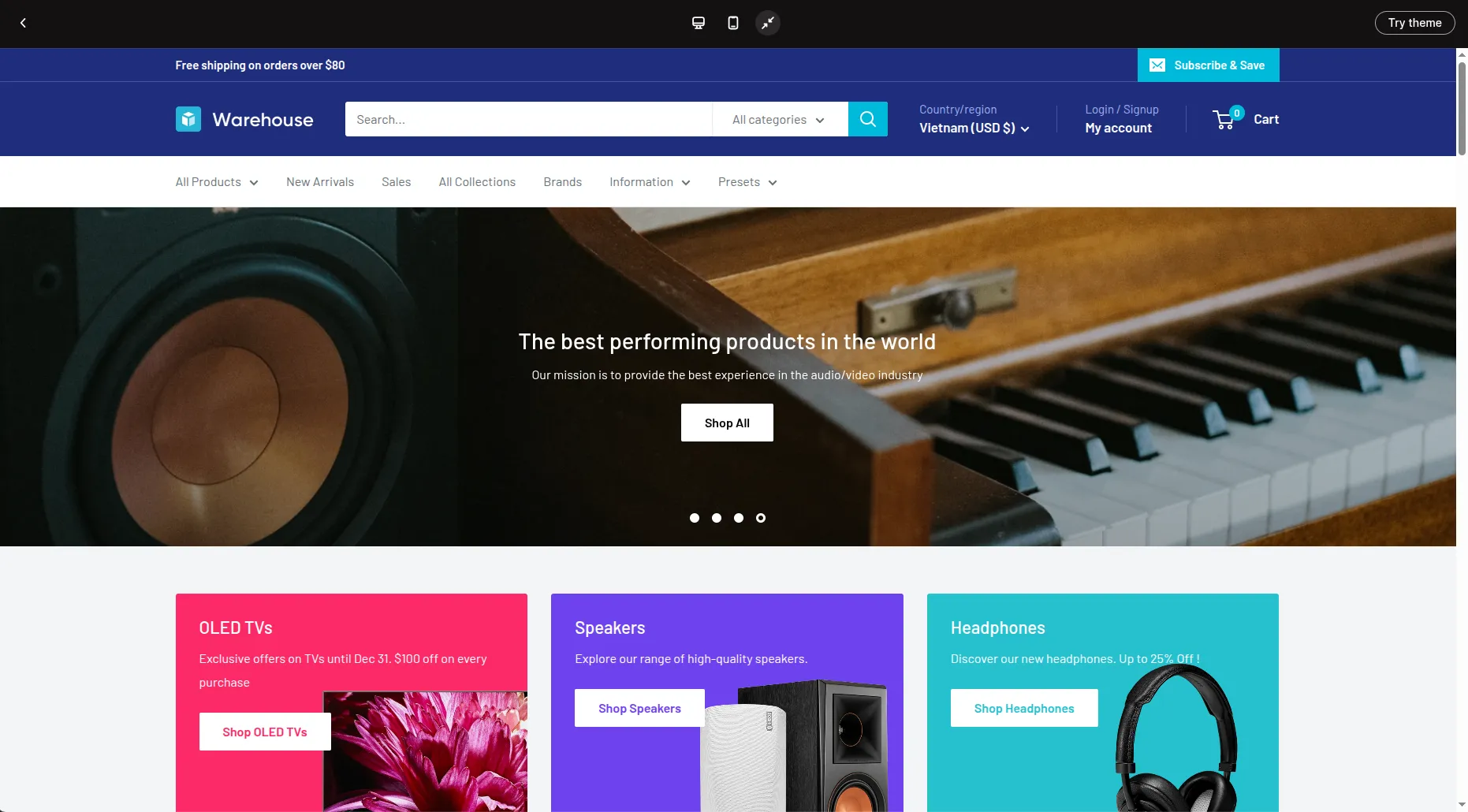
Warehouse: built around collection pages
Does a catalog of thousands need a theme built around its collection pages? Warehouse says yes, and its listing is blunt about it: collection pages meant to organize, present and filter thousands of products. Reviewers praise the developer’s support, though one July 2026 reviewer called it a sound base that costs time in upgrades and bug fixes if you have no developer on hand. Its latest release, from March, is the oldest of the six. At $320 it fits a collection-led retail catalog where wholesale ordering isn’t the point.
Empire: strong on variants, split on reviews
Empire’s 79% positive score is the lowest among the paid six, and it still earns a look. The listing promises advanced filters, a bold mega menu, product comparison and a quick order list, and its newest release rebuilt the variant picker for products with many options. About one reviewer in five didn’t leave a positive review, yet the four newest praise Pixel Union’s support. At $360 it costs more than Warehouse, so it suits a retail catalog where variants, not wholesale ordering, are the headache.

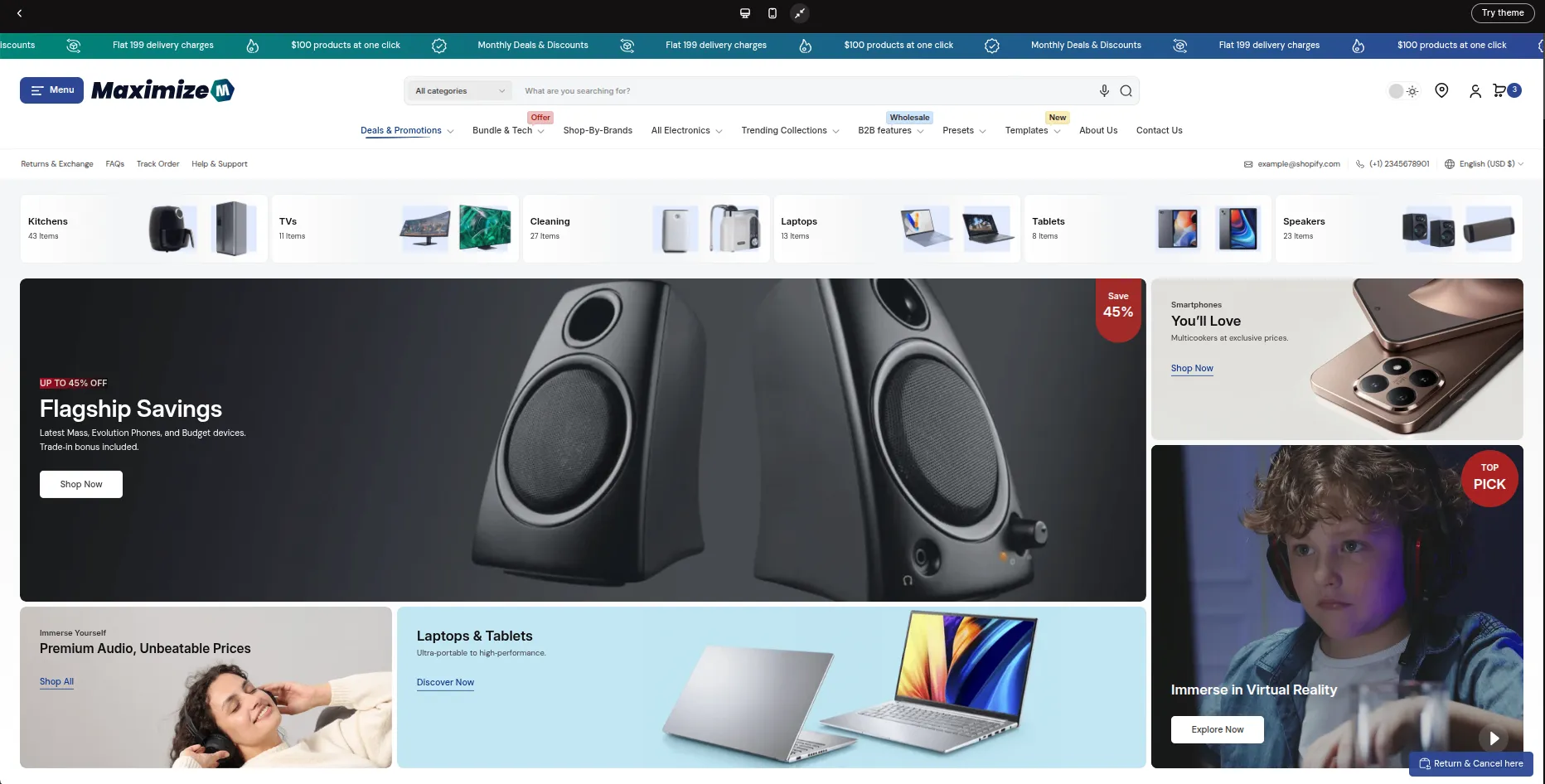
Maximize: wholesale tools at a lower price, on a thinner track record
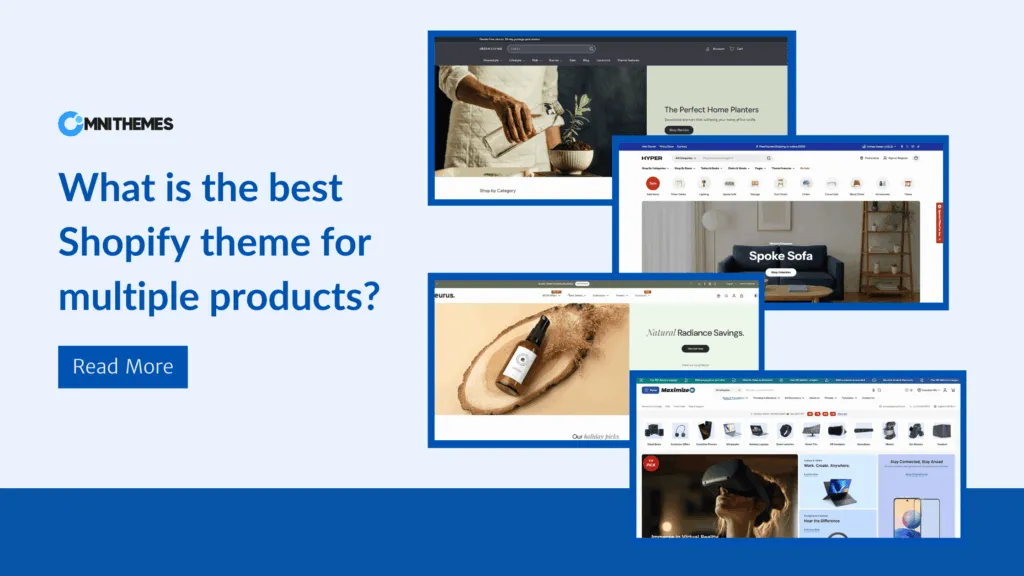
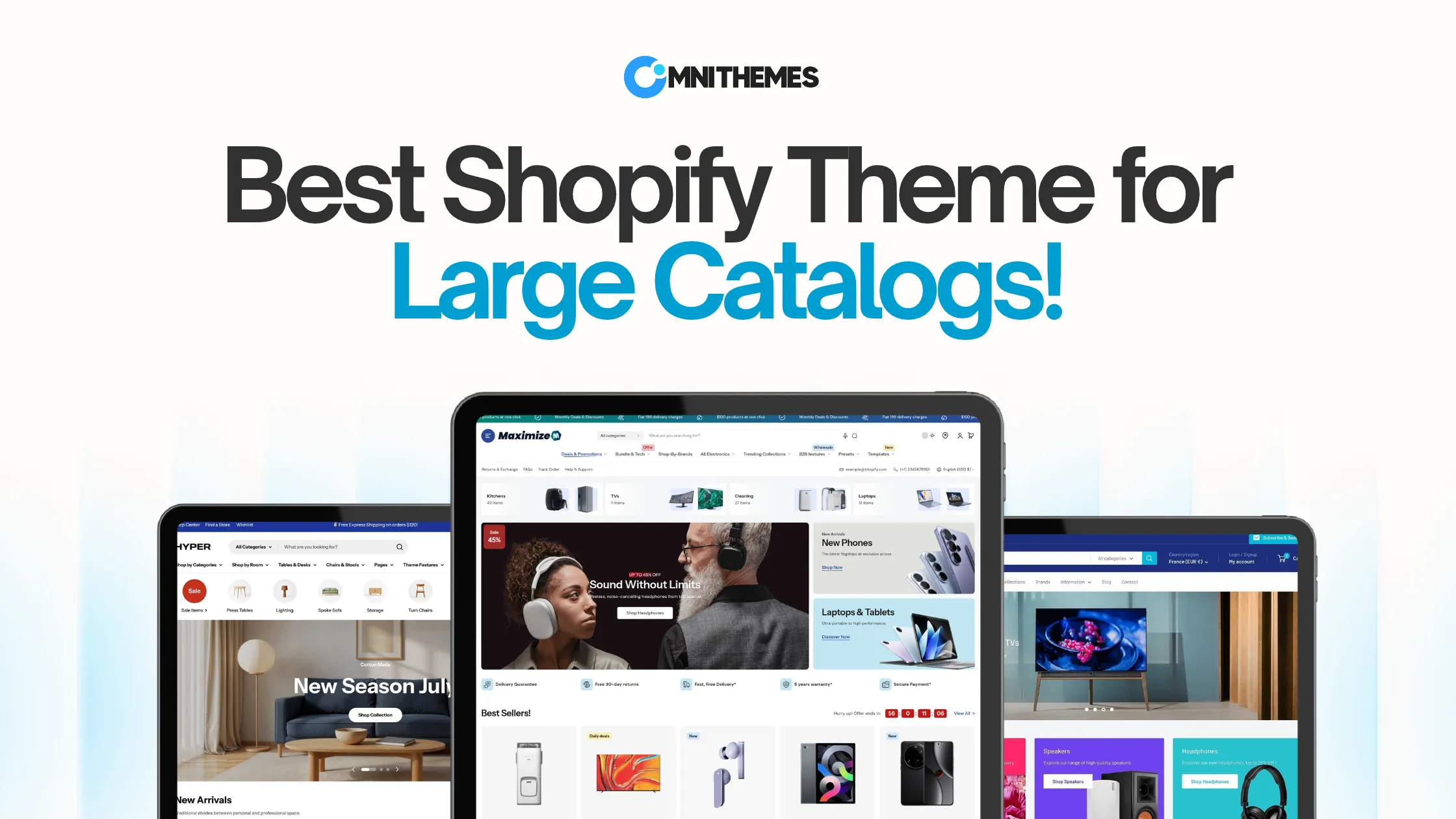
Maximize is developed by Omni Themes, and its case is price plus wholesale tools. At $220 it is the cheapest paid theme here, and its listing includes a quick order list, quantity pricing and a wholesale login for exclusive prices that it says needs no apps. The latest release added a mobile dock and extended menus to four levels for large catalogs. The weak spot is evidence: a perfect score rests on only 56 reviews, the thinnest base of the paid six, and that is the thing to weigh against the price.
Hyper: the strongest record, at a premium price
The usual objection to Hyper is price, and the usual answer is its record. It is the second-priciest of the six, yet 523 reviews at 99% positive is the strongest combination of volume and score on the list. The listing shows a quick order list, quantity pricing, built-in product comparison and bundles, and the latest release made variant switching and quick view faster. It is the safest bet when wholesale buyers shop next to retail ones and the budget stretches.

Trade: free and wholesale-only, with a rough review record
Free is the headline for Trade, and it is also the only theme here built for wholesale and nothing else. It is Shopify’s own, it ships a quick order list, and trying it costs nothing. The reviews are the price: 32% positive across 41, including a June reviewer who found that the quick order list checks stock only at the cart and shows no stock levels, which stings when a buyer has just built a long list. It suits a wholesale-only store testing demand; the listing shows no presets, so a mixed catalog may outgrow it.
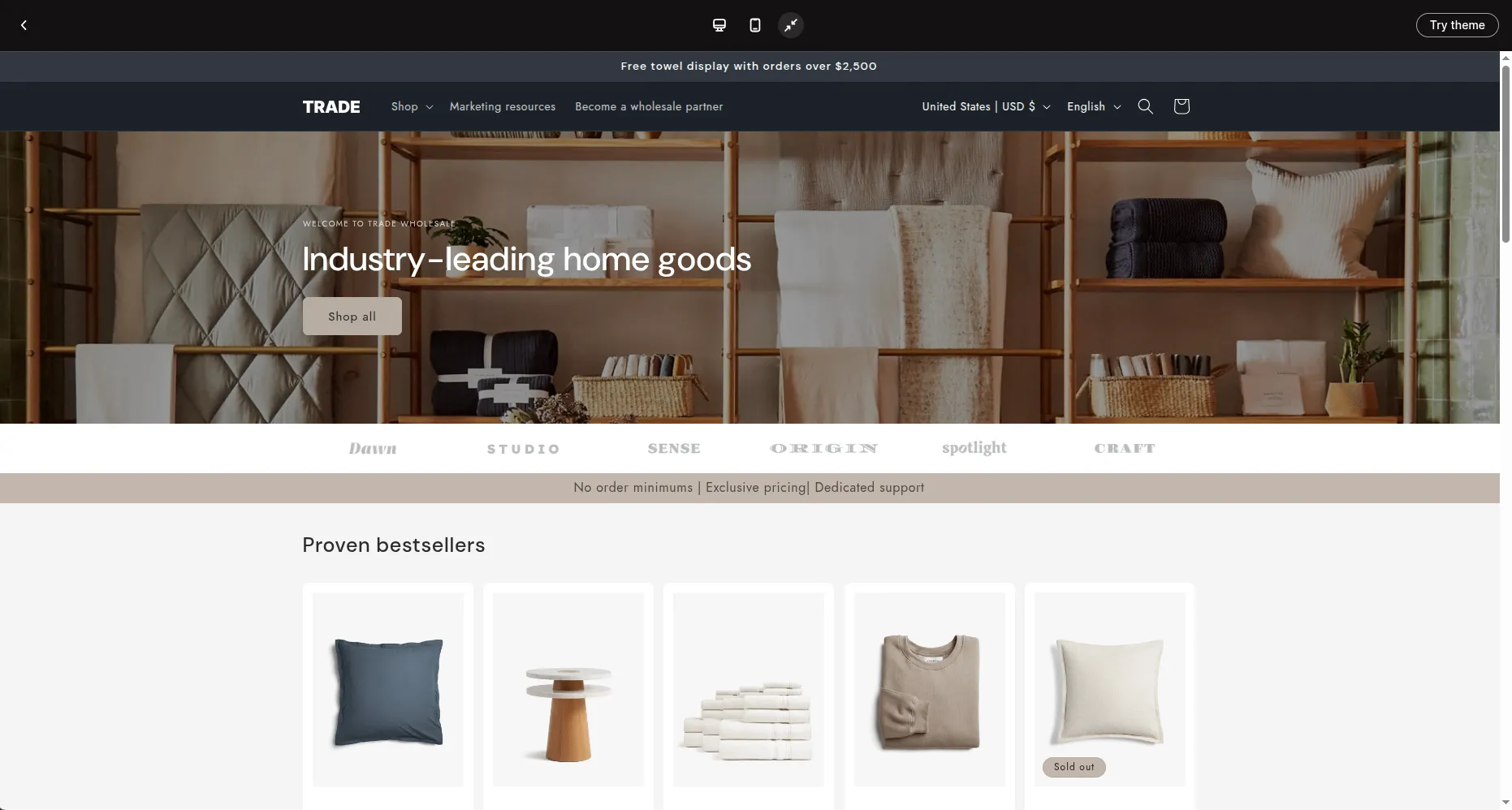
Our full Trade theme review goes deeper on what the free theme can and can’t do.
How do Maximize, Warehouse, Empire, Enterprise, Hyper and Trade compare on B2B tools and updates?
The B2B columns come first because they separate these six better than any discovery feature does. The Plus tag on quantity pricing is a listing label, and the wholesale section below explains why it understates what your plan can do.
Theme | Presets | Quick order list | Quantity pricing | Latest version on listing |
Enterprise | 3 (Enterprise, Outlet, Homestead) | No | Not listed | 2.3.0, April 20, 2026 |
Warehouse | 3 (Warehouse, Wood, Mesh) | No | Listed, tagged Shopify Plus | 7.0.1, March 13, 2026 |
Empire | 5 (Empire, Circuit, Depot, Vast, Forma) | Yes | Not listed | 14.0.0, October 23, 2026 |
Maximize | 5 (Maximize, Vigor, Various, Swift, Tender) | Yes | Listed, tagged Shopify Plus | 2.2.0, October 20, 2026 |
Hyper | 5 (Hyper, Nexvo, Ceramide, Trove, Pillar) | Yes | Listed, tagged Shopify Plus | 1.5.0, October 2, 2026 |
Trade | None listed | Yes | Described in overview as a Plus feature | 16.1.1, November 2, 2026 |
Which theme suits a store that sells to shoppers and wholesale buyers?
Maximize, Hyper and Empire all pair a quick order list with a full retail shopfront, which is what a mixed store needs; Hyper fits if the budget stretches, Maximize if it doesn’t. Start with the order screen, because that is the theme’s job. The Plus tag on quantity pricing is not the guide it looks like: Shopify’s B2B plan page lists quantity rules and price breaks on Basic, Grow, Advanced and Plus alike. The real limits sit in Shopify, not the theme. Standard plans get three active B2B catalog assignments, and only Plus can assign a catalog straight to one company, so check that your price tiers fit before you fall for any demo.
For a closer look at the wholesale side, see why Maximize suits B2B stores.
Which theme handles products with hundreds of variants?
Empire is the theme whose latest release notes address many-variant products most directly. Shopify raised the per-product limit to 2,048 variants in October 2025, and a product page has to keep up with that. Empire’s newest release rebuilt the variant picker and says every product template now supports products with many variants. Hyper’s notes mention faster variant switching, while the notes shown for Maximize and Trade don’t mention variants at all. That isn’t proof of a gap, so ask the developer and test one real product with hundreds of options before you buy.
Which large-catalog theme gives the most for the money?
The $180 gap between Maximize and Hyper is the real value decision, with Warehouse and Empire priced in between. A theme is a one-time payment per store, so judge the price over years rather than months, and weigh it against the proof behind it: a few dozen reviews and several hundred are different amounts of evidence. Every Theme Store theme can be customized before you pay, so the sticker price is a risk you can test cheaply.
Frequently Asked Questions
So which theme should you try first?
The worry from the top still stands: demos are easy, four thousand products are not. For a mixed store, Hyper has the track record to be the safe pick; for a retail catalog led by collections, Empire or Warehouse; and Maximize when wholesale tools at a lower price matter more than a long review history. Whichever you shortlist, the downside is small, because every Theme Store theme can be tried with your own products before you pay.
Load a few hundred of yours into two themes this week and browse them on a phone, starting with the Maximize theme and its demo if wholesale is on your list. A theme can’t organize your catalog, but it decides how easily shoppers use it.